By Muriel Porter
24 March 2026
Victorian Anglicans Together had a pleasant, well-attended and helpful meeting with Archbishop Thorpe at St George’s, Malvern, on 10 March. We were also delighted that Mrs Louie Thorpe was able to join us.
A wide range of issues was canvassed, with a welcome opportunity for members to ask questions of the Archbishop across the friendly hour-long discussion.
Archbishop Thorpe began proceedings by reminding the gathering that Melbourne had elected a mission-minded archbishop. My focus, he said, “is on helping people to get to know Jesus and to walk with him. I would encourage you to join in the mission or let me join you in a mission of your own.”
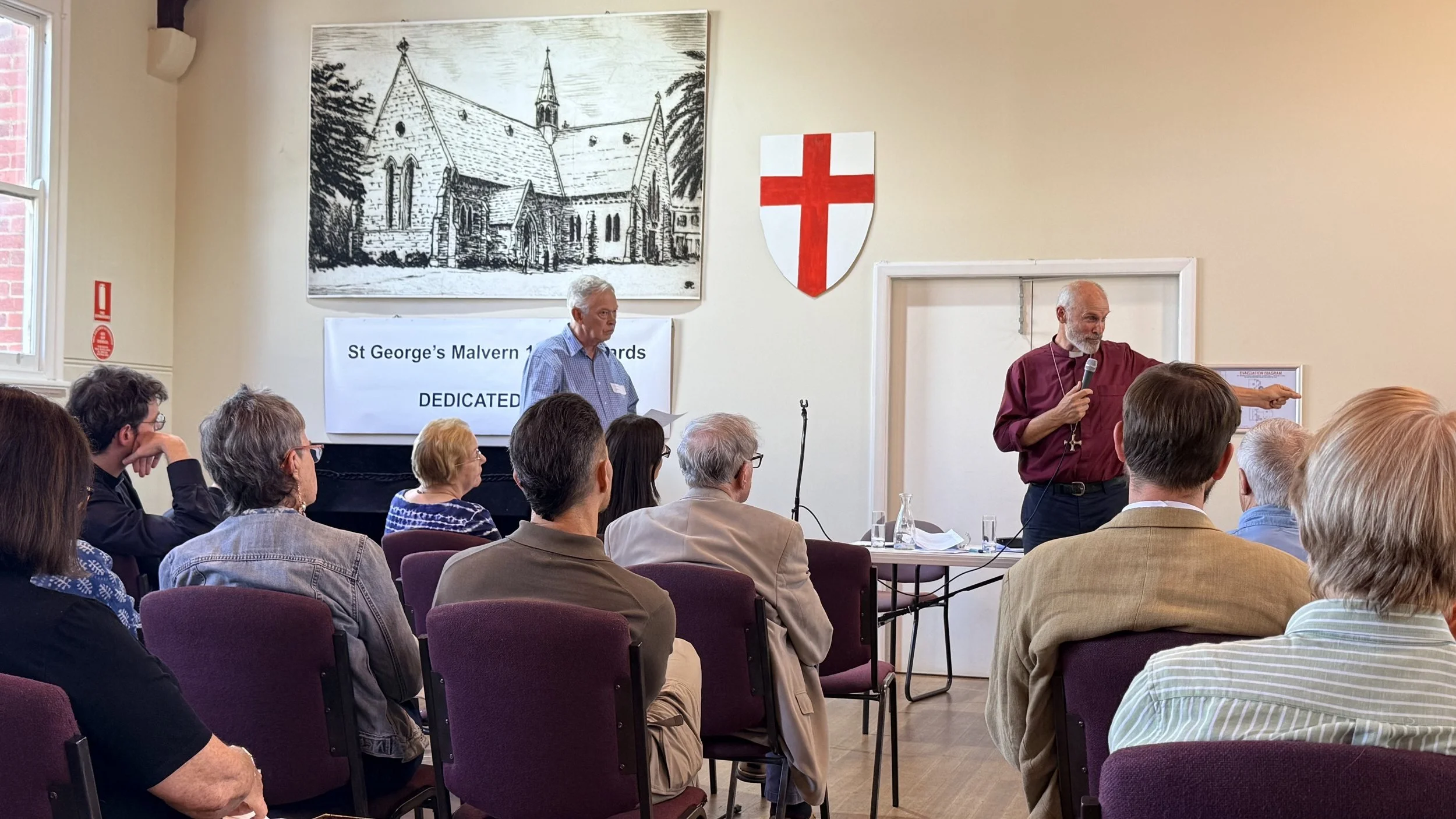
The Archbishop talking with VAT members. Image credit: Supplied.
Noting that this could be done in different ways, he said that “our diversity is our strength”. With many different cultures in Australia, we would experience more and more diversity. There would be disagreements at times, but we needed to learn to disagree well. “It starts with listening, genuinely listening to each other, and putting ourselves in others’ shoes. We can’t fulfil the kingdom of God if voices are diminished.”
To support diversity, he continued, we needed to ensure that governance bodies did not just represent the interests of the few; they needed to represent as far as possible the whole spectrum of Anglicanism.
The first question from the floor came from Prue Borthwick, (St Bartholomew’s, Burnley) who asked about small parishes, and how they can engage in the process of revitalisation. There are no silver bullets, Archbishop Thorpe replied! Some parishes – faithful, looking outwards, loving and blessing their community – had huge potential for more and needed some kind of investment to catalyse something more to happen. Other parishes had tried everything and nothing was working, so one possibility was a group from another church could come to help re-energise the parish. He spoke of a frame he had found very helpful: “honour the past to navigate change in the present and build us for the future”.
He touched on the problem of financial viability faced by a number of parishes: “Some would say that the model of church we’re doing is very expensive”. Again, a partnership approach could help. Wealthier communities could help poorer communities. When parishes started giving sacrificially, “something changes in us as well, and we begin to see our own discipleship change and develop.”
Canon Nigel Pope offered an outline of the ministry he was developing at St John’s, Footscray. When he came, “everything was in the negative,” he said, “including the numbers on Sunday, and sometimes you just never knew where to start from”. He began by praying and walking the streets of Footscray, making friends with the community – a model based on Jesus’ calling people into friendship. “Jesus said ‘let’s be friends’ and the world was changed, and we are part of that.” In this “befriending ministry” God had given the parish so many friends from outside the parish. While they had not all joined the church, they had energised and encouraged the church. The parish might still be struggling financially, but in all his years in ministry he had never seen the spirit of God at work in such a concrete way.
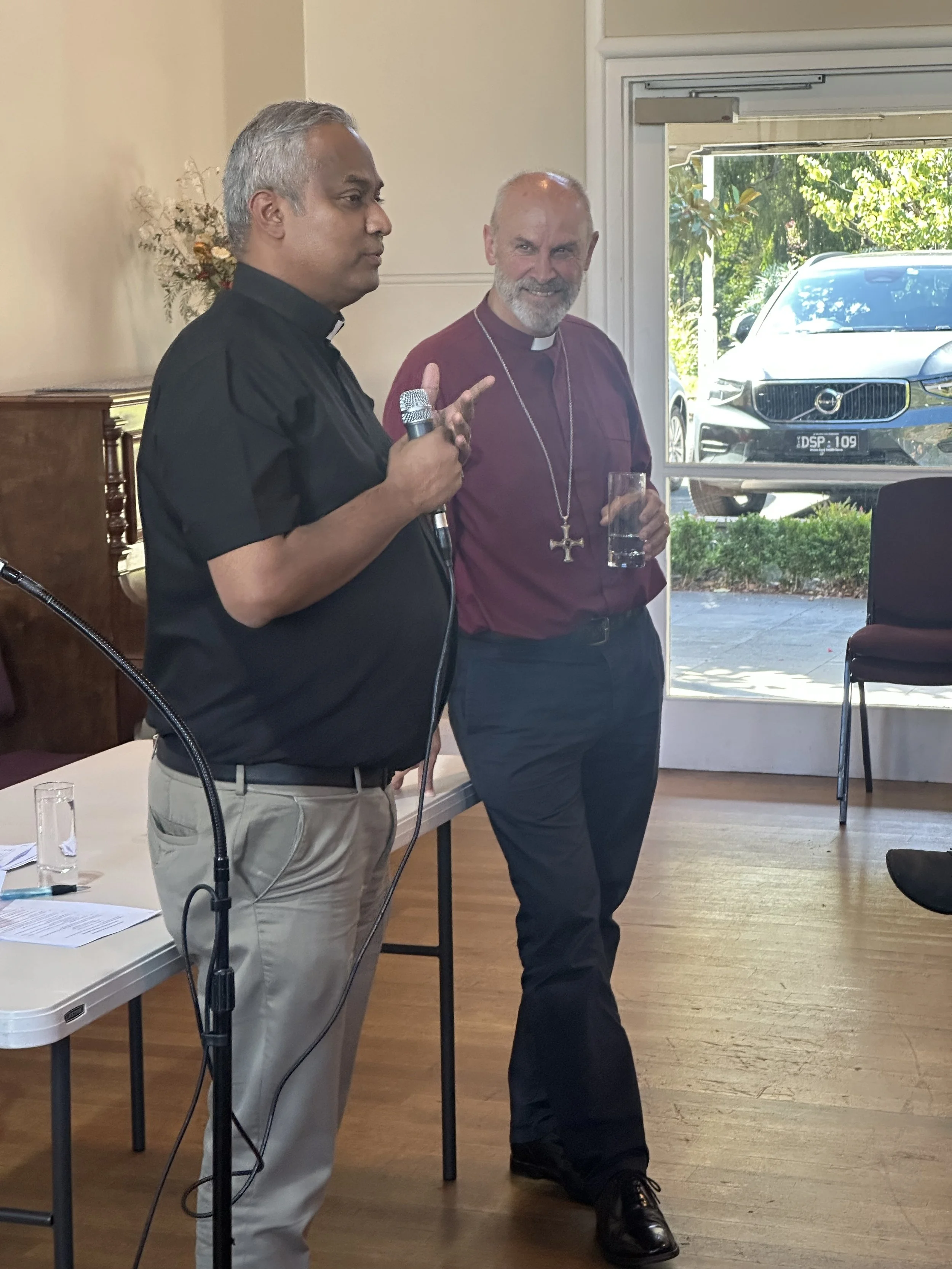
The Archbishop and Canon Nigel Pope. Image credit: Supplied.
Professor Dorothy Lee raised concerns with the growth of complementarianism in the diocese. It was painful to see, including for some Evangelical women who shared her concerns that there were ordinands saying they would not work with a woman vicar or be obedient to a woman bishop. While she accepted the notion of diversity, diversity could not be absolute. For instance, racism and sexism were simply not on. What will the diocese do in relation to those who have real difficulty with the ordination of women?
Archbishop Thorpe affirmed his total support for women in ministry in all three orders. He had been pleased to work with Bishop Sarah Mullally in London and would be attending her installation as Archbishop of Canterbury, God willing in the current war situation. But, he warned: “you might not like this”. He accepted that it was possible to argue a different point of view from Scripture. “I can’t say that is absolutely wrong. I just disagree with it. For me it is not a first-order issue that defines whether you’re a Christian or not”. The question was how we could work together. “The way I tackle this is that we need to treat one another with respect, with integrity, with humility, with great love”, he said. He hoped that we would see the raising up of women bishops, priests and deacons under his leadership.
Dr Leonie Bird, (St George’s, Malvern), noting that “we stand still in the shadow of the Royal Commission”, spoke of the challenge to the church from government legislation concerning compliance in a range of areas. We were, she said, confronted with the state now directly intervening in the church. How do we deal with this change? she asked.
Dr Thorpe replied that in his view, we needed to go beyond legislation. The way to break the cycle was to get well ahead of it. He would like to see a healthy diocese so far ahead of all the components that the state would be coming to us saying, “Gosh, can you help us? Because actually what we're seeing in you is not really ticking lots of boxes, but your whole culture is different.”
Sally Petty (St Margaret’s, Eltham) asked about the diocesan financial situation, to which Archbishop Thorpe replied that there were “some amazing people who have had to make some savings and TMA was part of that process”. He said he was really sad that TMA had closed, but the reality was that there were 35 subscriptions for “something that cost hundreds of thousands of dollars”. “So we were subsidising a newspaper where we were having to make decisions to close other things in order to keep the newspaper going”. He added: “We've got better communication tools than we've ever had before. I think we need to work out together what is the best way to communicate to people in every area”.
To Paul Williams’ (St Stephen’s, Richmond) question about the need for older generations to pass on the faith to younger people, Archbishop Thorpe quoted a Church of England statistic: only one-third of Christian parents were prepared to pass their faith on directly to their children because they wanted them to decide for themselves. “I have to say, that means the death of the Church,” he said.
The meeting concluded with a blessing from the Archbishop, followed by a delicious afternoon tea prepared by Julia Charleston.