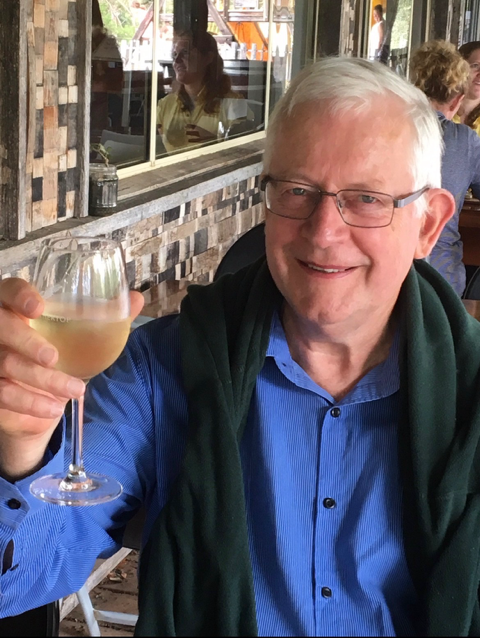
Image credit: supplied.
The moving Requiem Eucharist for the Reverend Roger Prowd at St Peter’s Eastern Hill on 5 March was not just a fitting farewell for a much-loved Melbourne priest but also offered deep solace to the mourners who packed the church, particularly from the eulogies delivered by Bishop Kate Prowd and their daughter Cordelia. Their account of Roger’s deeply faithful, prayerful journey following his shock cancer diagnosis last September, and his family’s loving journey with him, was a profound witness to the Christian faith. Victorian Anglicans Together is privileged to share the eulogies with you. You can listen to the eulogies at the 24 minute mark in the video of the funeral: https://www.vividstream.com.au/live/roger-prowd.
“If you can’t make it happy, make it beautiful” (The Rev’d Dr Sam Wells and Bishop Jo Bailey Wells)
Eulogy by Bishop Kate Prowd
When one becomes a bishop, it doesn’t take long to discover that there are others who imagine themselves to be wearing the same coloured shirt, even your own shirt! But I can say with a degree of confidence that today, none of you envies my place.
And yet, it is my honour to stand here.
When Roger was diagnosed with stage four brain cancer (glioblastoma), I wrote to the Monomeeth episcopate and said that I had found myself on a pilgrimage not of my choosing. But in time I came to realise that I had already chosen this pilgrimage – nearly forty-two years ago when I said, in the presence of God, “I will”, to Roger. I simply had not reckoned on the shale and shards, the steep escarpments and seemingly impossible climbs that these past months would hold for us.
A very dear friend wrote to me upon hearing the news of his diagnosis, “Well pilgrim. You can do this hard thing. One step at a time, with God and all of us with you.” A few centuries earlier, Cardinal John Henry Newman expressed the same sentiment in his hymn ‘Lead, Kindly Light’, where he wrote: “One step enough for me.” And that became our Way—taking just the next step.
Though Roger was ahead of me in this understanding. For years he kept what he called his ‘Day Book’, filling it with stories, quotations, and theological reflections gathered from erudite writers across the centuries. These past nearly six months, I read from it to him, and he to me. Our former Archbishop, Philip Freier, suggested that the Day Book had perhaps prepared Roger for this part of his journey. That comment struck a chord when I came across this quotation in the Day Book from the twentieth century cellist, Pablo Casals: “The situation is hopeless. We must take the next step.”
In the end, Roger could no longer take literal steps. But spiritually and emotionally, he did. We did. When everything appeared hopeless, we took the next step—his toward eternity, mine toward a life I did not want: life with Roger in a new way.
Roger told me: “I don’t know how to do the dying bit”. Noble, honest words from a priest who had spent forty-one years preaching and teaching Christ and the hope of life everlasting. The dying was the bit of his pilgrimage I could not walk with him. Yet it was the hardest.
During his illness all three daughters expressed their loving relationship with their father. Cordelia provided a faithful, steady ministry of presence. Phoebe tirelessly tilled our neglected garden, creating out of seemingly nothing much, something of real beauty that gave Roger such pleasure. Our youngest daughter Eleanor read almost daily to him from Tolkien’s The Lord of the Rings. I was hoping it would see him out!, but it was not to be…. Roger looked forward to these readings so much. He recounted to me how Frodo must set sail on the last part of his pilgrimage across the waters to reach the Undying Lands, a place promising beauty and rest, where, after his own significant suffering, Froda can find solace to die in peace. This will be the place where the evil influence of the ring is at last absent. Like Roger, Frodo must face this part of his journey without his beloved friends, but the journey itself promises healing. Roger’s thoughts about this brought him solace. “The waters (Roger told me) look beautiful”.
After Roger died, the messages we received carried a common thread: “He was a kind, gentle, wise, witty, loving, faithful man.” Roger was no saint!— But at the heart of all these qualities, I believe, was mercy. Roger had self-insight—and knew his own brokenness, and his need of God’s love and mercy. Like blind Bartimaeus who, when he approaches Jesus and cries: Have mercy on me!(Mark 10), Roger himself knew the gift of receiving this mercy. And he shared this same mercy that he himself received – extending God’s compassion, forgiveness, generosity and grace to so many throughout his life and ministry.
On the day of his brain operation, Roger phoned me, early. I want to tell you something, he said... I’ve been given a sense of God’s peace, and I hope it stays with me throughout the time remaining. God had given him a measure of healing—not of body, but of heart and soul. That sense of peace—beyond human understanding – steadied him. And although he described himself as ‘fragmented’ by the cancer, that unbidden gift enabled him to take the next step, even when the situation looked hopeless.
As his body weakened and words left him, he rested in that insight. Always, clutching his holding cross or placing it reverently beneath his pillow. Even the nurses knew to place it in his hand.
Another treasured friend (+Kelvin), unable to be here today, wrote this to me about Roger:
I'm glad his struggle is over even as I am deeply sorry for the loss of him. What I remember about him right now is a kind of disparity. He was such a big man– physically and emotionally and intellectually. He had a commanding air about him but the reality of his presence was something quite different than that. He was soft and knowing and sensitive. I remember particularly his sense of humour –the nose for a telling story, a sense of the ridiculous, the subtlety of his observations, all working through his wide reading and literate insight. I remember how his eyes crinkled in laughter behind his glasses as he explained yet another ridiculous situation. Of course, there was more than that.
In the news (he continues) I am faced daily with the insufferably miserable lives of rich men and know that Roger was richer than any of them: to have lived three score years and ten in selfless ministry and end it beloved by friends, by a wonderful wife and by extraordinary daughters. Wow. Well done, Roger, good and faithful servant, beloved of the Lord.
He concludes: All any of us ever possess is the square yard of God’s earth we are standing on right now. Roger inhabited his square yard fully and well, with love and humility and the right kind of strength. What more could anybody ask?
“To love another person is to see the face of God.” (Les Misérables)
In loving Roger, and being loved by him, I have seen that face of God. And I trust that now, in fullness, he does too.
Eulogy by Cordelia Prowd
In 2018, Mum and Dad moved into what was planned to be their retirement home in Ormond. It is a lovely house for two people, but unfortunately for them, I was still relying on their generosity and came with them. Soon after I had fashioned the room, Dad announced his intention to place his desk in there. According to him, everywhere else was ‘taken’! At the time, I really resented his desk (and accompanying presence). It caused almost enough irritation to rouse my departure – almost, but not quite!
But by the time they took the desk to Glen Iris years later, my irritation shifted
to fond affection for the desk, as I realised it embodied everything I loved about Dad. To start with, the smatters of papers. Anyone who met Dad quickly learnt that he couldn't organise his way out of a paper bag. If we each had a dollar for every time he asked us if we knew where his glasses were, we could have bought him a much-needed tracking device! But his warped concept of time also meant that he was never in a hurry if someone needed unexpected comfort or support.
Atop these desk papers were a variety of spiritual books and reflections. Rowan Williams, Markus Borg, Leunig... Dad was a learned man of quiet but very deep faith. He was continually moved by the affirmations of God's loving presence in his life. His understanding of God was a God of compassion, love and light overcoming darkness.
Dad's embodiment of his faith provided much comfort to those he ministered to. The recent outpouring of grief and many stories of Dad's care are a testament to his unfailing kindness. And his kindness was there to the last. Even when he was recovering from a craniotomy, he insisted on knowing where his wallet was so he could pay the taxi fare of the patient next to him – classic Dad!
Dad was also somehow able to find calm in the chaos, and some of my favourite memories of Dad are of peace: listening to Keith Jarrett together, quietly sharing lunch in the sunshine at Pallotti College in Warburton, and watching him read with his beloved grandchildren.
A tile depicting a New Zealand ‘korῡ [ko-roo]’ – an unfurling fern - sat in one corner of Dad's desk. This korῡ was given to Dad by a Maori community as a sign of respect. When talking about our years living in New Zealand, Dad always used the same words: "That was probably the happiest time in my life".
Just as a korῡ represents new life and hopefulness, Dad looked back on our time in New Zealand as one of growth and joy for each family member. Dad also loved New Zealand for its natural beauty. Dad took great delight in nature, and, like his favourite poet, Mary Oliver, he had a gift for seeing beauty in what others often fail to notice. As children we would impatiently hurry him along when he had noticed something ‘pretty’ or ‘lovely’ whilst we were trying to get on with ‘Life’! The kitchen table was always bedecked with vases or pots housing his latest discoveries.
There was one thing on Dad's desk that I am yet to mention. The family photo.
It held pride of place, just as family did for Dad. I remember Mum telling me once that if Dad ever had to go away, he would ring as soon as he arrived to tell us he'd done so and check that everyone was ok. He actually always did everything he could to make sure that the three of us were ok. Whatever our problem, his catchphrase was always, “Don’t worry, it will all work out”.
We are all quite different people but Dad, through unconditional love, devotion and perseverance, was able to reach each of us, and in turn, help us reach each other. He possessed a generosity of spirit that meant if there was ever an airport run to do, a forgotten item to deliver, a meal needed, or a kind word, Dad would be there. Without judgment.
After Dad's diagnosis, it was heartbreaking to realise that he would never sit at his desk again. We all wept when it was taken away—sold on Facebook marketplace for a mere $20! But it actually went to the home of a Solomon Islands pastor newly moved to Melbourne — who was so moved to hear that it had belonged to an Anglican priest. And whilst the desk items may be packed up and the family photo may take pride of place elsewhere, the qualities they reflected will stay with us.
We feel blessed to have had Dad as our father, and we will miss his steady love, care, kindness and companionship always.