By Philip Nicholls
24 March 2026
Holy Week and Easter at St Paul’s Cathedral offer a number of commemorations, some liturgical and others concerts: in addition to the daily Eucharist at 12.15pm, on Monday 30 March there is a performance of the Thomas Tallis Lamentations at 1pm; on Tuesday 31 March, Douglas Weiland’s The Twelve Words of Christ From and Beyond the Cross at 5.10pm; Choral Evensong on Wednesday 1 April at 5.10pm; and the usual Great Triduum services: 6pm Maundy Thursday 2 April; 9am Great Liturgy of the Passion on Good Friday 3 April; 6am Great Vigil of Easter on Sunday 5 April; and Festival Choral Eucharist at 10am and Choral Evensong at 4pm, also on Easter Day Sunday 5 April. On Good Friday 3 April at 3pm there is, as usual (!), a liturgical performance of John Stainer’s The Crucifixon. ‘Why?’ I hear some bemoan! ‘Again?!’
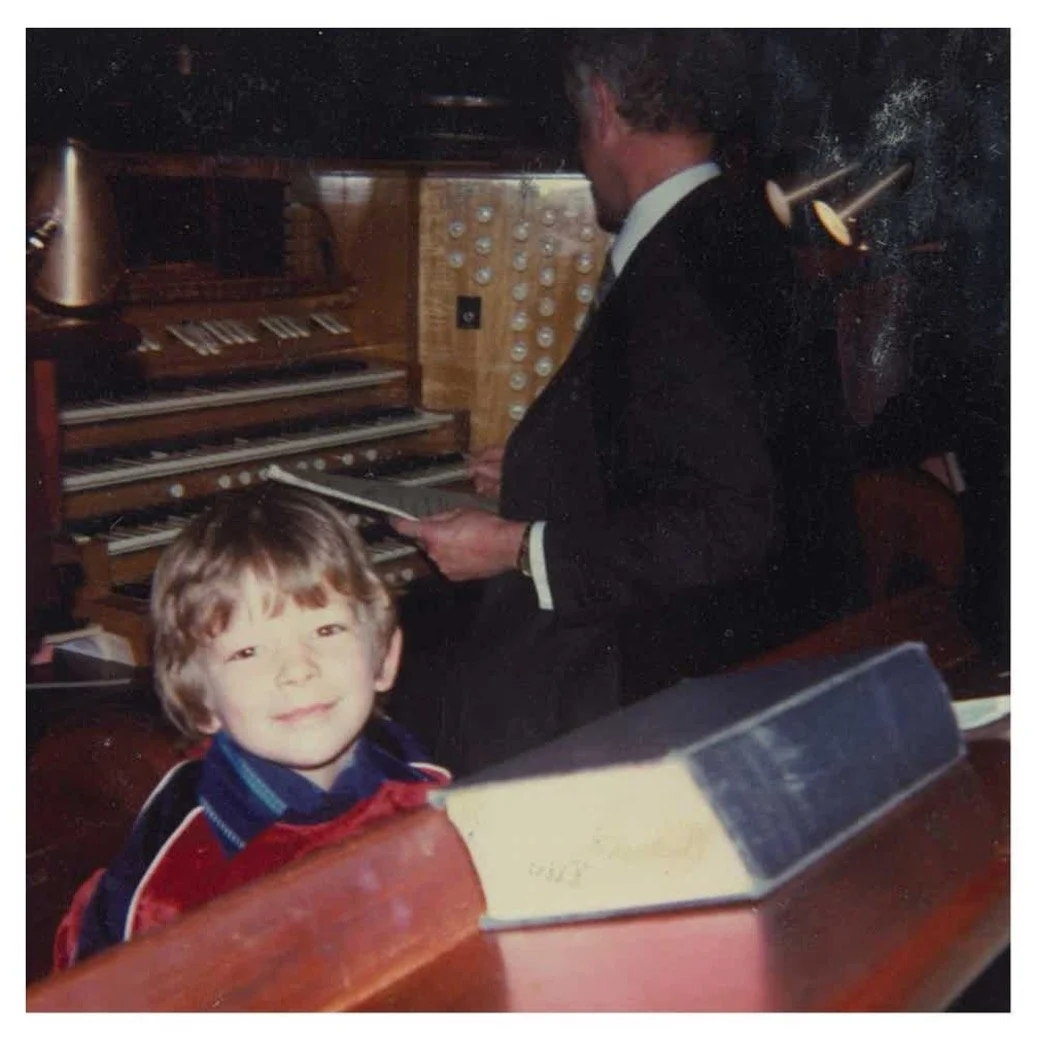
My dad was a prodigiously talented church musician: he was appointed Organist at St Andrew’s Clifton Hill aged 13. He read mathematics and physics at the University of Melbourne whilst organist at the former Cairns Memorial Presbyterian Church, and enjoyed a career as a consulting Patent Attorney. In 1961 he was appointed Organist & Choirmaster at St John’s Presbyterian then Uniting Church Essendon, where he served, with a few significant breaks, until his death in 1997. During one such break, he was Organist and Choirmaster at The Scots’ Church Melbourne from April to September 1981 – here I am, with him at the Scots’ organ. There’re a lot of stories about that very short period of his stewardship of the musical traditions of that place, but they’re for another time!
I am privileged to have his music and books about music, and inside the cover of one is this letter to the editor of The Age, undated, but it must be around Easter in some year between 1950 and 61.
It shows his turn of phrase, and displays common attitudes towards John Stainer (1840-1901) his sacred oratorio The Crucifixion (1887).
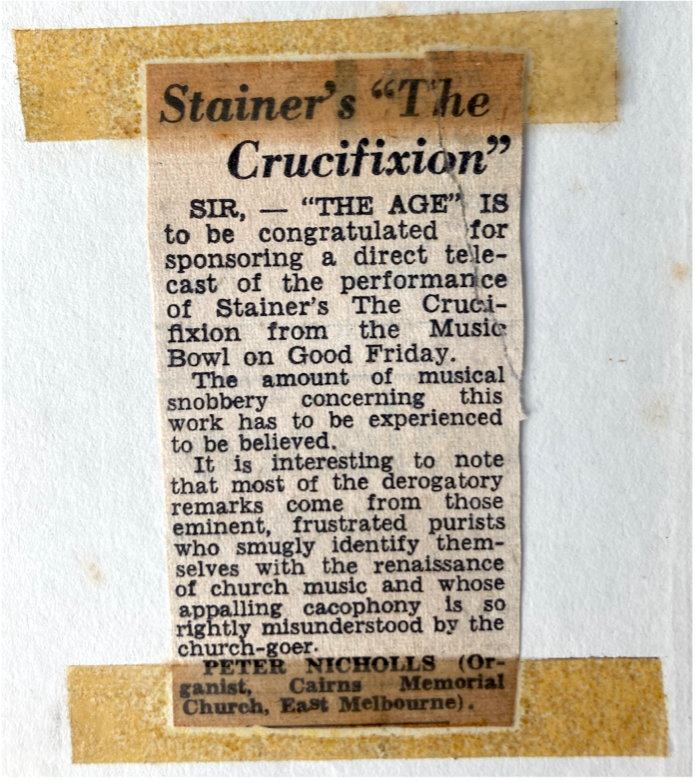
I must admit, these were attitudes I shared prior to my appointment to St Paul’s Cathedral in 2013. I could simply not understand why this piece was sung in the Cathedral on Good Friday every year, and why it had continued almost without a break since 1892.
My first memory of the piece is not from St John’s Essendon (where I must’ve heard it as a boy) but from school, when visionary music teacher John Kirkham programmed it one year. I can’t remember who sang the solos, but I’m pretty sure dad was on the organ. I was taken by what I thought was a childish wonder at the beauty of the melodies and the simplicity and brilliance of its harmonies. It was not until I first directed it that I understood that this wonder was not immature, but rather, worthy of further study.
Quite simply, The Crucifixion is captivating, and if one can sit willingly with its late-Victorian language and aesthetic, there is a lot to learn. It was composed at the same time as our cathedral was designed and built, and so shares much of its aesthetic values. And looking at Stainer’s preferred organ registrations in the piece (the organ stops or sounds he wants to be used) and comparing them with the specification (or list of sounds/stops) of our cathedral organ, one sees that it is perfectly suited to accompanying Crucifixion.
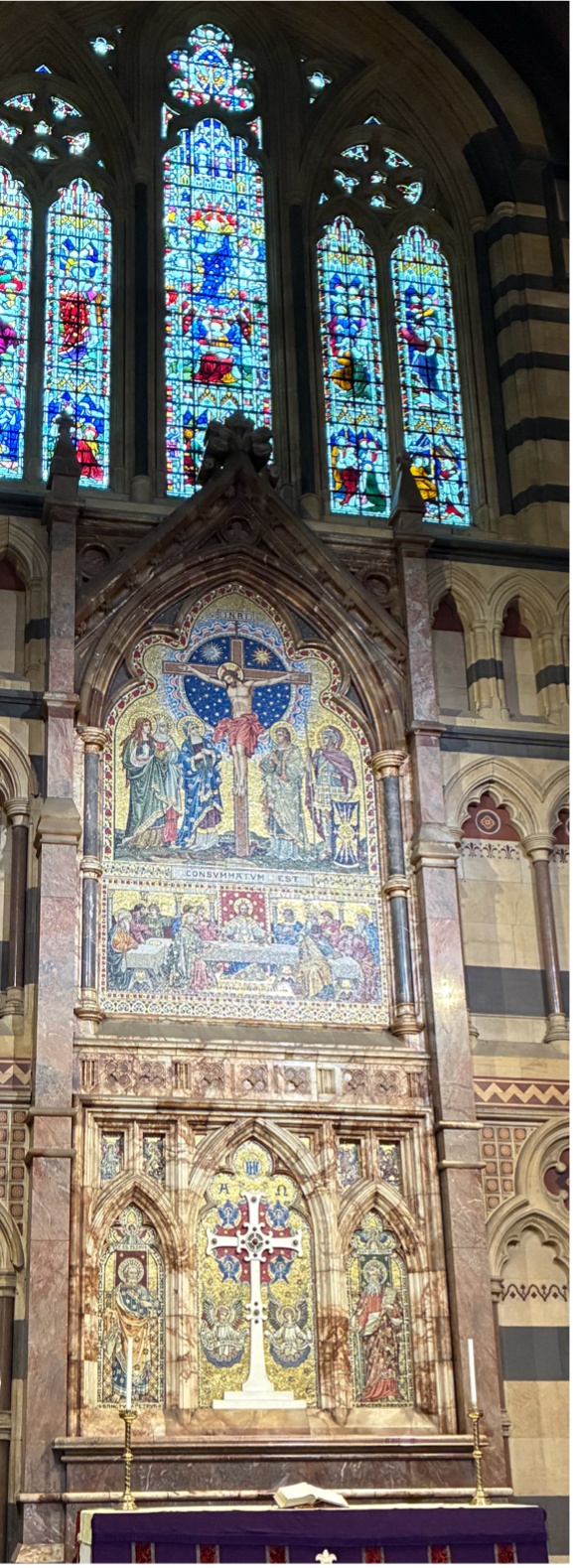
After my dad left Scots’, my family had a period of not going to church together, or at all. My brother Richard began singing at Christ Church Brunswick and thought it would be a good musical education for me. My dad knew Revd Paul Harvie (the somewhat eccentric curate of the parish who had begun a choir of boys and men there in the 1970s) as a fine organist and musician, and my parents agreed that, should I be keen, I should join that choir. I did and so was formed in the Sarum worshipping traditions of that place, which perform a Theology of the Cross as the debasement of Jesus of Nazareth – not only did God humble Godsself to be found in human form, but underwent torture and a cruel and spiteful death in order to redeem creation, and all that means for the humanity that crucified him. Of course I understood that this stumbling block led to the glory of resurrection, but a slightly more reformed theology is required to allow that Jesus was indeed ‘Crucified into Glory’. This is the theology of The Crucifixion, and it is rendered visually in all aspects of the design of St Paul’s Cathedral – both those as intended by its architect William Butterfield, and those added by later hands – especially in its reredos, ‘Consummatum est’.
Having experienced The Crucifixion for twelve years now (this will be my thirteenth, allowing a year’s gap for COVID!) along with the literally hundreds of people for whom this is a Good Friday tradition, I now understand why the piece and its performance have enjoyed so much longevity here in the home church for Anglicans in Melbourne and Victoria. I encourage you to come and experience it too. 3pm Good Friday 3 April.
Canon Philip Nicholls is the Director of Music at St Paul’s Cathedral, Melbourne.